Staff week 2025 “Business Learning Decoded: Empowering Educators To Shape Tomorrow's Leaders”
12. oktoober 2025
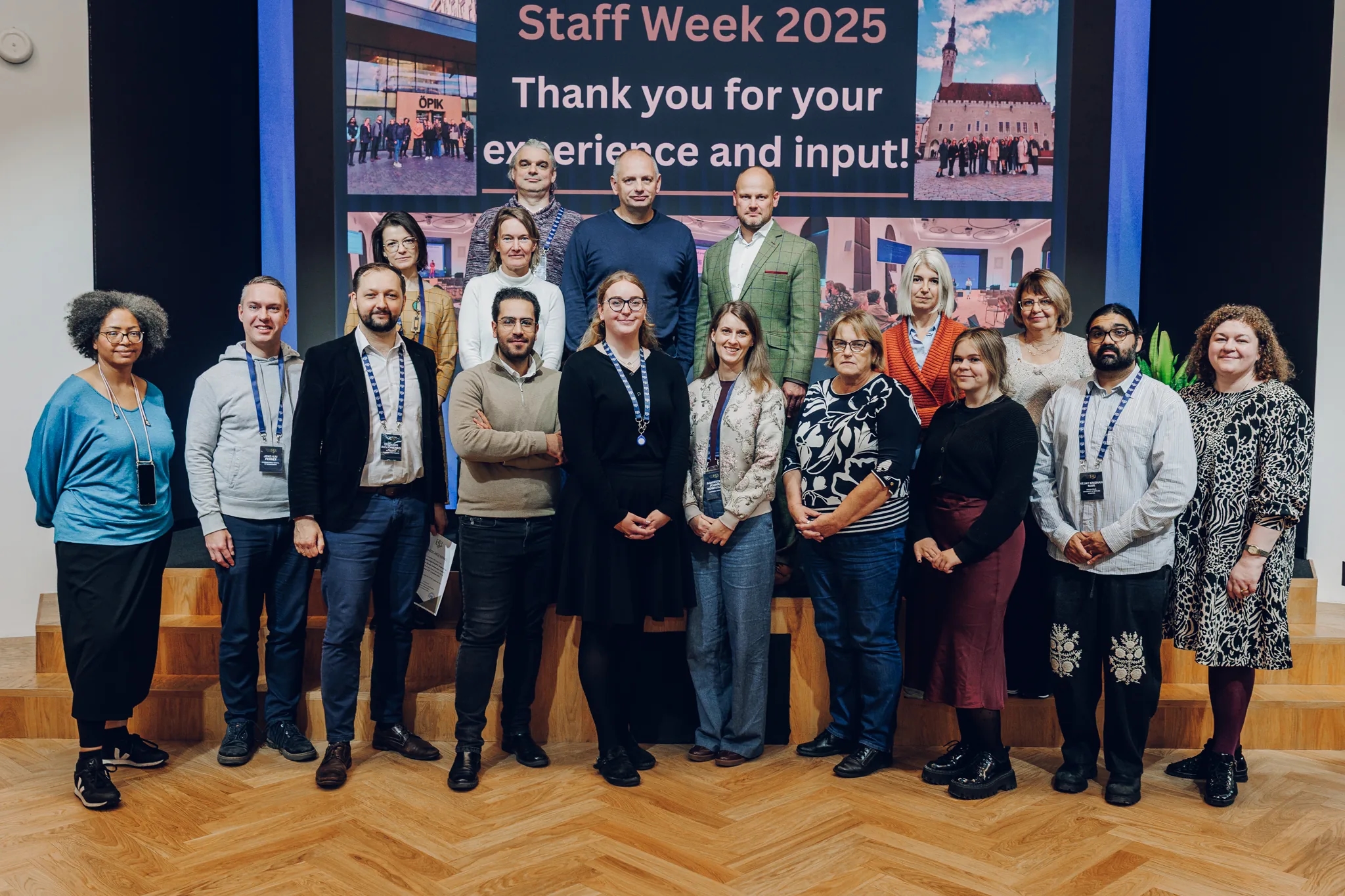

As the global landscape of business evolves at lightning speed, educators face an unprecedented challenge: preparing the next generation of leaders to thrive in an ever-changing world. This autumn, the Estonian Business School undertook that challenge head-on with its 2025 Staff Week, titled “Business Learning Decoded: Empowering Educators to Shape Tomorrow’s Leaders.”
Between the 29th of September and the 3rd of October, participants took part in various activities, amongst which highlights were:
- Workshop “Story-based Curriculum Development to Unlock Entrepreneurial Mindset” led by Marge Täks, guiding educators and curriculum developers to integrate entrepreneurial competencies into well-designed learning experiences while tackling pedagogical and institutional challenges.
- Workshop “Reinventing Business Education” led by Maarja Murumägi, Kille-Ingeri Liivoja and Karolina Kuusik, examining global trends shaping business education and demonstrating tailored learning experiences that help educators navigate this evolving landscape.
- Workshop “Is ESG Dead?” led by Anu Ruul, exploring the future of environmental, social, and governance principles in business strategy.
Participants also had a chance to discover Tallinn through various tours and were part of a unique bog experience offering a creative and natural backdrop for reflection and collaboration.
“In its 2030 strategy, EBS builds on its entrepreneurial DNA to deliver high-impact learning, support venture creation through research, and expand its international reach. A strong global network of partner universities is key to this ambition. The Graduate Management Admission Council named Estonia the Greenest Country to Study Abroad in 2025, recognising EBS as a leading example of sustainability in business education. During the recent Staff Week, we shared our approach to story-driven programmes, integrating coding with business, and promoting sustainable innovation. I look forward to working with our partners to offer students meaningful international experiences, advance pedagogy, and encourage an entrepreneurial mindset.” – Anto Liivat, Head of Bachelor's and Specialist Master’s Programmes
A warm thank you to the University of Oulu, University Politehnica of Bucharest, Gisma University of Applied Sciences, Banku Augstskola, Kozminski University, The National University of Ostroh Academy, Haaga-Helia University of Applied Sciences, KLU Kühne Logistics University, Recep Tayyip Erdogan University, International School of Management, Germany, Eötvös Loránd University GTK and Riga Technical University for being part of this week and contributing to the exchange of ideas shaping the future of business education.
Funded by the Erasmus+ Programme.
Teised uudised
Mohammad Toyon’s Doctoral defence highlights retention of working university students in Estonia
On December 18, 2025, at Estonian Business School, Mohammad Abu Sayed Toyon stood before a defence committee to present five years of work on a question that affects students more than most universities and policymakers care to admit: what happens when students have to work to pursue their education?
The defence, led by Associate Professor Riina Koris, brought together Associate Professor Maarja Beerkens from Leiden University and Senior Lecturer Oleg Badunenko from Brunel University as opponents. Both praised the thesis for clear research questions, rigorous focus, and genuine relevance.
Beerkens noted that she was initially sceptical about measuring dropout intention rather than actual dropout, “but I see it’s really well argued now... You convinced me entirely why this is a valid measure, perhaps even a better measure.” Badunenko emphasised the thesis’s value in “highlighting the realities of working students, how they see education and how universities need to align with this new reality.”
The supervisors, Professor Kaire Põder and Assistant Professor Niveditha Prabakaran Pankova, spoke with affection about the journey. “It was five years ago, 2020, when we first saw you,” Põder recalled, noting that Toyon entered during the pandemic, part of a cohort that learned to be independent researchers while isolated. “You were sitting in Sillamäe alone, no social capital, no peer effect, very limited teachers’ effect.” Pankova, who joined EBS the same year as Toyon, described growing together: “He’s my first PhD student... I could relate to him a lot because I was in his shoes not very long ago.” There was laughter when they recounted Toyon arriving with 300 pages, saying, “The thesis is done.”
After a brief deliberation, the committee returned with three unanimous votes in favour, awarding Toyon the degree of Doctor of Philosophy in Management.
But the research itself demands attention beyond the ceremony. In a room full of academics, Toyon’s findings landed differently because they weren’t abstract. They were about the students sitting in every classroom, working night shifts between lectures, choosing between rent and textbooks.
Understanding the work: A conversation with Dr Mohammad Abu Sayed Toyon
What is your research about, and why does it matter?
My research focuses on the retention of working university students. It matters because retention is not only about keeping students enrolled, but also about how they are treated after they enter university. Just as organisations pay attention to the experience after a purchase (post-purchase experience), universities must recognise that students arrive with expectations, responsibilities, and lives that extend beyond the classroom.
This research centres on working students and gives them a voice. In Estonia, one in three students identifies primarily as a worker, and 37% of working students cannot afford higher education without paid employment. Yet higher education has long been imagined for a different kind of student: one with time to spare, sufficient financial security, and a life arranged neatly around the academic calendar. But today’s students live differently. They work to pay rent, to support families, and to build a future that cannot wait.
When institutions fail to recognise this reality, students rarely fail loudly; they simply leave. This research shows which groups of working students are most at risk of dropping out, why relationships within universities matter, and what working students need while integrating study and paid work. It also highlights what universities can do to better support them and help them stay.
What has the doctoral journey been like for you?
The doctoral journey has been full of memories, challenges, and insights. One of the most meaningful moments for an academic is seeing their academic works accepted by scholars in the field and made publicly available. This brings a sense of validation and motivation to continue contributing to the knowledge community, and I am no exception.
One of the main challenges has been learning that success in science is not only about what you know, but also about how well you communicate it and meet the expectations of others.
Who from the faculty has been instrumental to your journey?
Everyone at EBS has contributed in different ways, but Professor Kaire Põder has been especially instrumental in supporting and guiding my journey.
What has been the most rewarding part of this process?
The relationships and connections formed during this journey have been the most rewarding. Education is not a destination, but a never-ending path. What makes it meaningful is the sense that something uncertain still lies ahead, along with the hope that keeps one moving forward.
What advice would you give to other doctoral students or those considering a PhD?
I would advise thinking carefully before enrolling in a PhD programme, as it is very different from master’s-level study. It is not simply a matter of enrolling, publishing a few articles, writing a monograph, and then saying goodbye to the university. A PhD is a process of capital accumulation, where you build resources through connections, skills, and, most importantly, self-reliance.
What is next for you after the defence?
After the defence, I plan to focus on upcoming projects and continue applying the skills and insights gained throughout this academic journey.
Dr Mohammad Abu Sayed Toyon defended his doctoral thesis, “Retention of Working University Students in Higher Education: Insights from the Estonian Context,” on December 18, 2025, at Estonian Business School. The thesis was supervised by Professor Kaire Põder and Assistant Professor Niveditha Prabakaran Pankova. The defence committee was chaired by Associate Professor Riina Koris and assisted by EBS Research and Doctoral Studies Coordinator Sigrid Lainevee, with opponents Associate Professor Maarja Beerkens (Leiden University) and Senior Lecturer Oleg Badunenko (Brunel University London).
19. detsember 2025
Teised uudised

Mohammad Toyon’s Doctoral defence highlights retention of working university students in Estonia
On December 18, 2025, at Estonian Business School, Mohammad Abu Sayed Toyon stood before a defence committee to present five years of work on a question that affects students more than most universities and policymakers care to admit: what happens when students have to work to pursue their education?
The defence, led by Associate Professor Riina Koris, brought together Associate Professor Maarja Beerkens from Leiden University and Senior Lecturer Oleg Badunenko from Brunel University as opponents. Both praised the thesis for clear research questions, rigorous focus, and genuine relevance.
Beerkens noted that she was initially sceptical about measuring dropout intention rather than actual dropout, “but I see it’s really well argued now... You convinced me entirely why this is a valid measure, perhaps even a better measure.” Badunenko emphasised the thesis’s value in “highlighting the realities of working students, how they see education and how universities need to align with this new reality.”
The supervisors, Professor Kaire Põder and Assistant Professor Niveditha Prabakaran Pankova, spoke with affection about the journey. “It was five years ago, 2020, when we first saw you,” Põder recalled, noting that Toyon entered during the pandemic, part of a cohort that learned to be independent researchers while isolated. “You were sitting in Sillamäe alone, no social capital, no peer effect, very limited teachers’ effect.” Pankova, who joined EBS the same year as Toyon, described growing together: “He’s my first PhD student... I could relate to him a lot because I was in his shoes not very long ago.” There was laughter when they recounted Toyon arriving with 300 pages, saying, “The thesis is done.”
After a brief deliberation, the committee returned with three unanimous votes in favour, awarding Toyon the degree of Doctor of Philosophy in Management.
But the research itself demands attention beyond the ceremony. In a room full of academics, Toyon’s findings landed differently because they weren’t abstract. They were about the students sitting in every classroom, working night shifts between lectures, choosing between rent and textbooks.
Understanding the work: A conversation with Dr Mohammad Abu Sayed Toyon
What is your research about, and why does it matter?
My research focuses on the retention of working university students. It matters because retention is not only about keeping students enrolled, but also about how they are treated after they enter university. Just as organisations pay attention to the experience after a purchase (post-purchase experience), universities must recognise that students arrive with expectations, responsibilities, and lives that extend beyond the classroom.
This research centres on working students and gives them a voice. In Estonia, one in three students identifies primarily as a worker, and 37% of working students cannot afford higher education without paid employment. Yet higher education has long been imagined for a different kind of student: one with time to spare, sufficient financial security, and a life arranged neatly around the academic calendar. But today’s students live differently. They work to pay rent, to support families, and to build a future that cannot wait.
When institutions fail to recognise this reality, students rarely fail loudly; they simply leave. This research shows which groups of working students are most at risk of dropping out, why relationships within universities matter, and what working students need while integrating study and paid work. It also highlights what universities can do to better support them and help them stay.
What has the doctoral journey been like for you?
The doctoral journey has been full of memories, challenges, and insights. One of the most meaningful moments for an academic is seeing their academic works accepted by scholars in the field and made publicly available. This brings a sense of validation and motivation to continue contributing to the knowledge community, and I am no exception.
One of the main challenges has been learning that success in science is not only about what you know, but also about how well you communicate it and meet the expectations of others.
Who from the faculty has been instrumental to your journey?
Everyone at EBS has contributed in different ways, but Professor Kaire Põder has been especially instrumental in supporting and guiding my journey.
What has been the most rewarding part of this process?
The relationships and connections formed during this journey have been the most rewarding. Education is not a destination, but a never-ending path. What makes it meaningful is the sense that something uncertain still lies ahead, along with the hope that keeps one moving forward.
What advice would you give to other doctoral students or those considering a PhD?
I would advise thinking carefully before enrolling in a PhD programme, as it is very different from master’s-level study. It is not simply a matter of enrolling, publishing a few articles, writing a monograph, and then saying goodbye to the university. A PhD is a process of capital accumulation, where you build resources through connections, skills, and, most importantly, self-reliance.
What is next for you after the defence?
After the defence, I plan to focus on upcoming projects and continue applying the skills and insights gained throughout this academic journey.
Dr Mohammad Abu Sayed Toyon defended his doctoral thesis, “Retention of Working University Students in Higher Education: Insights from the Estonian Context,” on December 18, 2025, at Estonian Business School. The thesis was supervised by Professor Kaire Põder and Assistant Professor Niveditha Prabakaran Pankova. The defence committee was chaired by Associate Professor Riina Koris and assisted by EBS Research and Doctoral Studies Coordinator Sigrid Lainevee, with opponents Associate Professor Maarja Beerkens (Leiden University) and Senior Lecturer Oleg Badunenko (Brunel University London).
19. detsember 2025