Ride the wave or be the lighthouse? Leadership choices in times of change
2. veebruar 2026
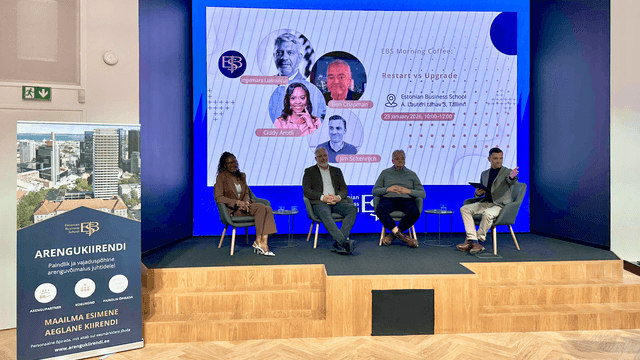
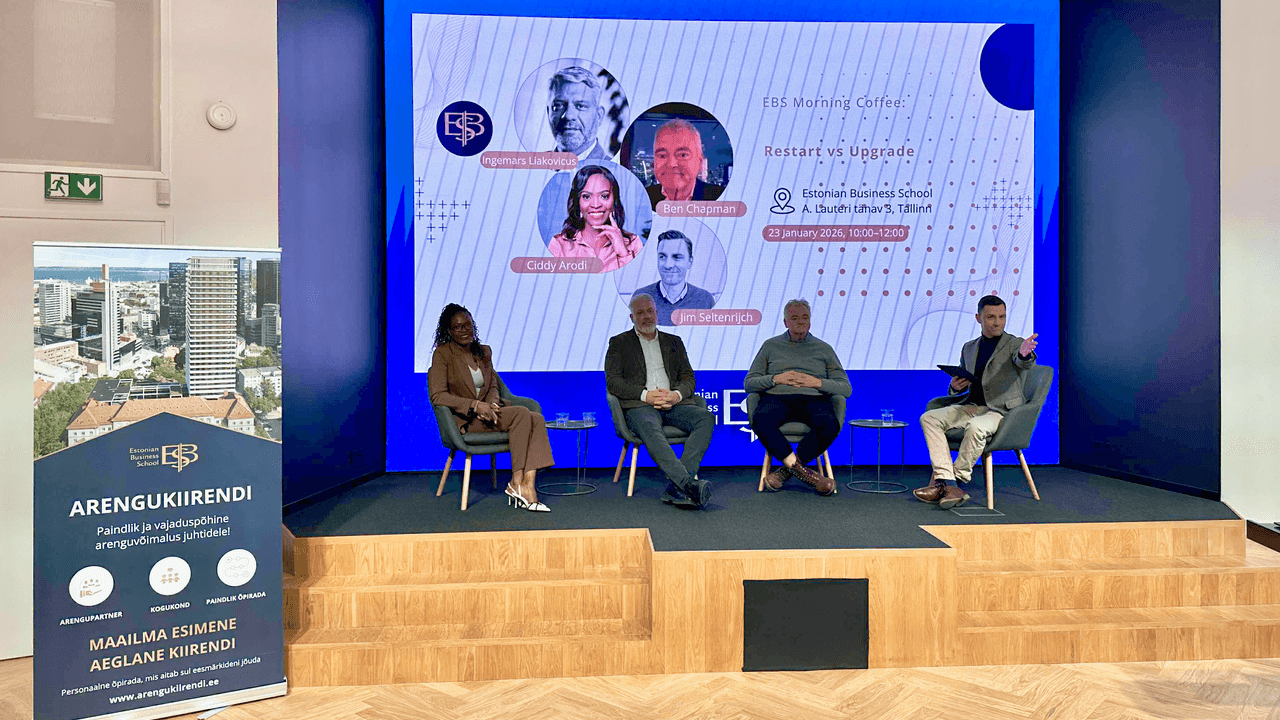
In the midst of change, every leader must decide: ride the wave or be the lighthouse.
At the January EBS Growth Accelerator morning coffee, we focused on how to maintain direction and clarity in a context where uncertainty has become part of everyday leadership.
On 23 January, the morning session “Change vs Stability – Ride the Wave or Be the Lighthouse?” brought together internationally experienced leaders and development partners at EBS to discuss change management in the face of global crises and daily reorganisations.
At the heart of the discussion was a central leadership tension: the need to adapt and evolve on one hand, and the responsibility to provide stability, clarity and predictability for teams on the other – especially when operating across multiple countries, cultures and time horizons.
The conversations highlighted a leader’s ability to listen, to frame uncertainty and to make decisions under pressure. Tools and methodologies were discussed, but above all the focus remained on people – and on recognising the limits where the pace of change begins to exhaust a team.
Frameworks for change: culture, size and growth phase
Moderator Jim Seltenrijch framed the morning around two perspectives on change: cultural differences and the organisation’s size and growth phase – from micro-enterprises to large multinational corporations.
This opened a discussion on both the systemic change management of large corporations and the practical dilemmas of small and medium-sized enterprises, where multiple roles are often concentrated in the hands of one person.
A clear message emerged from the panel: there are no universal solutions. The same change may require a completely different leadership style, pace and communication approach depending on the context.
Ben Chapman: change management is always about people
The morning was opened by international finance and interim executive Ben Chapman, whose nearly 40-year career spans major consulting firms, global corporations and change programmes in more than 40 countries.
In his presentation, “Change Management – Introduction and Overview,” he emphasised a simple yet often underestimated truth: at the heart of every change are people – regardless of how technological or process-driven it may initially appear.
Ben described change management as a journey from the current state to a desired outcome, requiring the simultaneous mobilisation of people, processes and technology. Too often, organisations focus on implementing a new system or IT solution, assuming that once the system is in place, people will follow. In reality, a project succeeds only when people understand why the change is happening, what lies ahead and how they will be supported along the way.
He illustrated his points with examples ranging from cultural specifics in Japanese pharmaceutical companies to global crises such as the Covid pandemic and the impact of the war in Ukraine. He also recalled the stories of Blockbuster, Netflix and Nokia – powerful reminders of how costly it can be to ignore signals for change at the right time.
In large organisations, he noted, change management has become a distinct competence. Dedicated global change teams help business units interpret the impact of change, manage risks and maintain a focus on people rather than just project timelines.
For smaller companies, adopting all the “Rolls-Royce” tools is neither realistic nor necessary. However, the mindset can be borrowed: someone must see the bigger picture – which changes affect whom, and when the organisation truly has the capacity to absorb them.
Ciddy Arodi: culture, pace and change fatigue
Panelist Ciddy Arodi, an experienced leader and change implementer with a background in international customer service organisations and development projects in Africa, shared how differently the same change can unfold depending on organisational culture, market and growth phase. She stressed the importance of viewing change through the lens of people, not just process maps.
Her message was clear: what breaks people is not change itself, but opaque communication, poor timing and the feeling that decisions are made elsewhere without their voice being heard.
She also highlighted the role of culture. A product or change initiative that succeeds in one market may fail completely in another if local habits, beliefs and expectations are not understood.
Ciddy addressed the concept of a change portfolio – situations where organisations implement not one change at a time, but dozens in parallel. This often leads to “change fatigue.” She emphasised the need for visibility over both internal and external change drivers – such as regulations, crises and strategic projects – and for prioritisation and timing that prevents teams from operating in constant overload.
Her practical recommendation was to create a change register, managed as deliberately as a risk register. Each change should be assessed for its impact on customers, people, processes and systems, and implemented only when the organisation has the capacity to absorb it.
She also underlined the importance of change champions at different levels – people the team can turn to when official communications fade but questions remain.
Ingemars Liakovicus: glass ceilings, growth and the Growth Accelerator experience
At the conclusion of the session, Latvian leader and entrepreneur Ingemars Liakovicus shared his journey, drawing on more than 25 years of experience in developing organisations in both the private and public sectors – from furniture manufacturing and technology companies to managing national IT infrastructure.
In recent years, he has focused on growing a family-owned accounting and finance company, creating value not only in financial metrics but also in leadership systems.
Ingemars spoke candidly about the dilemma faced by founders of small and medium-sized enterprises: when the company’s value is closely tied to the founder’s personal relationships and daily involvement. Statistically, only a fraction of micro-enterprises become small companies, even fewer grow into medium-sized businesses, and fewer still become large organisations. This raises a critical question: how to build a company that does not collapse when the founder steps aside.
According to Ingemars, the Growth Accelerator is suited for leaders facing a clearly defined problem or strategic turning point – such as a growth ceiling, the need for restructuring, or the decision whether to prepare for sale or pursue aggressive expansion.
The programme begins with a real leadership challenge, not an abstract curriculum. Each participant is paired with a development partner for regular reflection, decision-making and next steps. Articles, tools and discussions are directly linked to the participant’s concrete challenge rather than theoretical case studies.
Co-creation case: stay, grow or sell?
During the interactive part of the morning, participants analysed a case prepared by Ingemars – a concise but realistic description of a company’s situation, financial indicators and strategic options.
Three strategic paths were examined:
Stay – continue with the current model and maintain a stable lifestyle business, assuming the environment remains favourable.
Go wild – pursue deliberate growth: involve investors, undertake mergers and acquisitions, enter new markets, and build teams and processes that reduce dependency on the founder.
Sell – strengthen structures and processes, increase transparency and readiness, and realise the created value through a sale.
Group discussions explored which path would be most reasonable in the given context, considering market conditions, owner motivation, team readiness and personal life stage.
An instant poll showed that most participants saw the greatest potential in the growth-oriented “go wild” option. However, they emphasised that before accelerating, thorough groundwork in strategy, structure and people is essential.
Next morning session: “Profit is there, cash is not – what went wrong in management?”
On 11 February, the next morning coffee will address a painful but familiar question: “Profit is there, cash is not – what went wrong in management?”
Valeria Kiisk (Redgate Capital) will focus on strategic financial management, understanding cash flow and the decisions that can either strengthen or undermine a company’s viability.
Growth Accelerator: when you are ready to commit to real change
If the morning discussion left you reflecting on a concrete leadership challenge, the Growth Accelerator is designed precisely for that.
You start with your real challenge, not an abstract programme.
You gain a development partner to help maintain focus and momentum.
You learn through a flexible pathway that combines individual work, meetings with development partners and other leaders, and group training sessions.
Everything you learn is immediately applicable to your own situation.