Morning Coffee at EBS: How to Find Growth Opportunities in Uncertain Times
7. aprill 2026
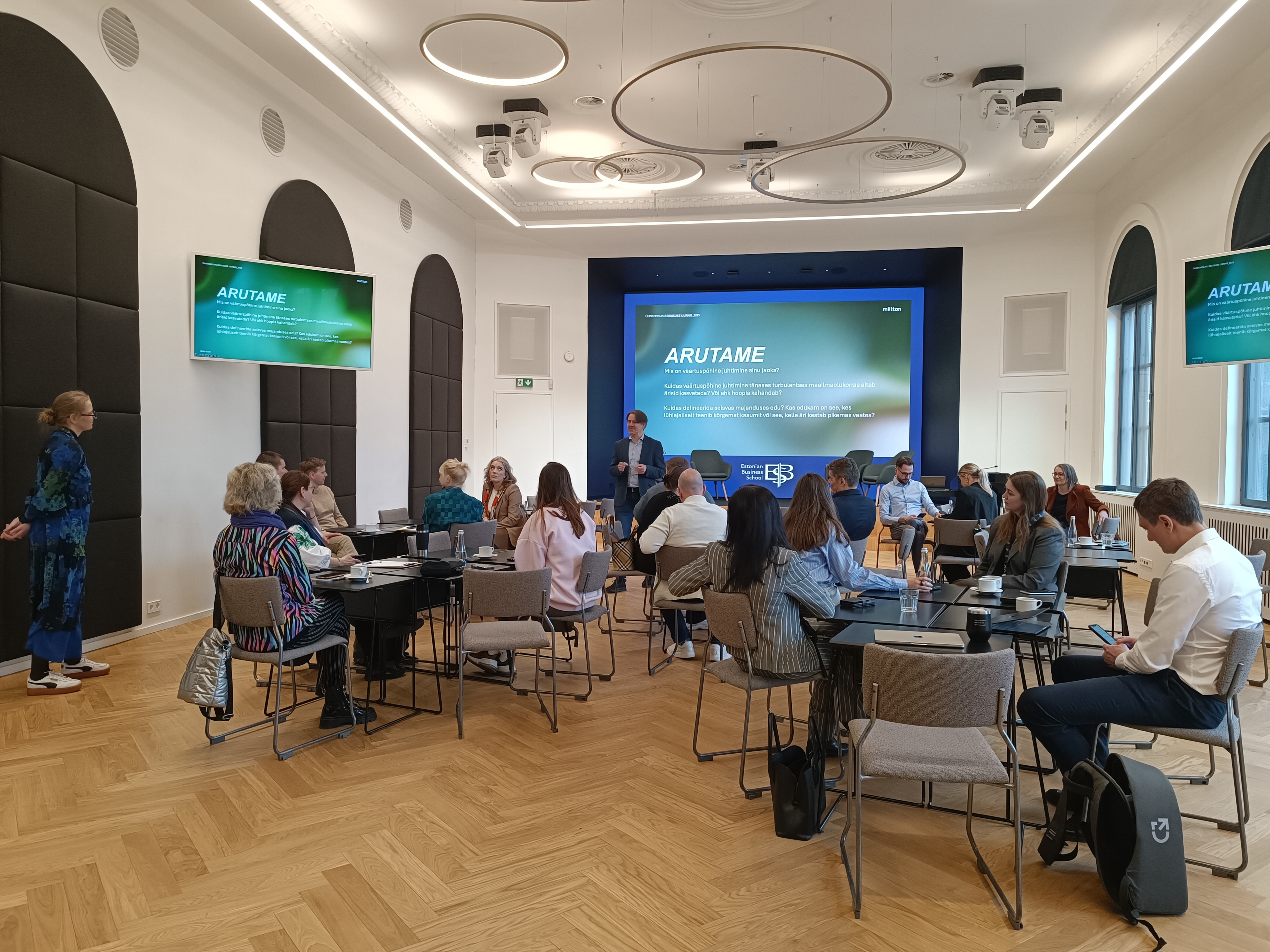
At the April Morning Coffee event at EBS, we explored one of the central questions of modern leadership: how to find growth opportunities in an environment where many primarily see constraints. This inspiring morning brought together experts from various fields to share practical experiences, discuss strategic choices, and explore how to make better management decisions in times of uncertainty.
Where Research Meets Practice
The morning was opened by Annika Arras (CEO of Miltton New Nordics), who presented the results of the 2025 Social Cohesion Study and directly linked them to leadership practice. One of the key findings of the study was that an increasing number of people perceive societal developments as uncertain and discouraging. This directly affects both consumer behavior and employee expectations—placing leaders in a position where decisions must be made amid declining certainty but persistent expectations.
Annika Arras also posed a thought-provoking question: what remains when social interaction is removed? This invites a deeper reflection on how much of our ability to act depends on our environment, relationships, and sense of belonging.
Panel Discussion: Insights from Different Sectors
The discussion was enriched by a panel featuring:
- Ander Hindremäe, Expansion Project Manager at Tallinn Airport and EBS MBA alumnus
- Kerstin Kütt, General Counsel at Sunly and EBS MBA alumna
- Annika Arras, CEO of Miltton New Nordics and EBS MBA alumna
The panel was moderated by Marko Rillo, Senior Lecturer in Strategy and Innovation at EBS and Head of MBA Programmes.
Bringing together perspectives from aviation, energy, and communications, the panel highlighted how differently “growth” can be defined across organizations.
Focus on Human Agency and Values
At the core of the discussion was human agency—the sense that individuals can influence their decisions and their lives.
A key takeaway was that values are among the strongest drivers of action. When individuals are able to act in alignment with their values, both their contribution and the overall capability of the organization increase.
At the same time, a critical question emerged: what happens when people lack the time and energy to learn new skills? In such cases, not only does development suffer, but belief in the possibility of innovation begins to decline.
Growth Is Not Universal
One of the central themes was the definition of growth. It became clear that growth is neither universal nor uniformly measurable—it depends on the organization’s stage of development and the expectations of its owners.
Growth can be defined, for example, as:
- an increase in volume or market share
- growth in impact or value
- development of organizational capability
What Holds Growth Back?
The discussion highlighted that one of the biggest barriers to growth is mindset.
Organizations often limit themselves by thinking too small and focusing on obstacles before fully exploring possibilities. Growth begins with a shift—from asking “why it cannot be done” to asking “how it can be done.”
Leadership quality plays a direct role here. When people are given sufficient autonomy and responsibility, real growth can emerge—not only in numbers, but in capability.
At the same time, everything ultimately comes down to communication. If people do not understand what is being done and why, genuine engagement does not occur. Team leaders play a particularly important role in translating strategic messages into everyday work.
Change Requires Conscious Leadership
A significant part of the discussion focused on change management. Rapid and large-scale changes are not always the most effective—the key factor is how well people are able to keep up.
Successful change management requires:
- clear and well-defined processes
- gradual involvement of people
- a consciously chosen pace
Organizations also emphasized the importance of mapping out possible future scenarios, so that people know how to act even in complex situations.
The Impact of EBS: Mindset and Practical Tools
The discussion also touched on the role of EBS in developing leaders. Participants highlighted two key values:
- the courage to think big
- practical tools gained from studies to support management decision-making
The Morning Coffee discussion at EBS confirmed that growth does not depend solely on the economic environment. Progress is possible even in uncertainty—if organizations maintain a strong focus on people, values, and deliberate leadership decisions.
Other News
EFMD-accredited studies give EBS students a global competitive advantage
The Business Administration bachelor’s programme at Estonian Business School has been awarded a five-year accreditation by the European Foundation for Management Development (EFMD) in 2025 – a recognition that confirms the programme meets international quality standards and provides students with a stronger position in both the job market and further studies.
EFMD accreditation is one of the most prestigious quality labels in business education. It is awarded to programmes that meet rigorous international criteria in terms of curriculum content, faculty qualifications, international outlook, practical relevance for the labour market, and alumni success. This means that EBS’s Business Administration programme operates at the level of the world’s leading business schools. Fewer than 50 programmes worldwide have received EFMD’s five-year top accreditation.
What does this mean for students?
Studying in an EFMD-accredited programme provides a clear competitive advantage:
- Stronger credibility with employers – graduates’ qualifications are highly valued, including by global companies
- Access to international study opportunities – a recognised degree opens doors to exchange programmes and master’s studies at top universities worldwide
- Future-proof education – programme quality is regularly assessed and continuously developed to keep pace with changes in the business environment
Why does this create a long-term advantage?
According to Anto Liivat, Head of Bachelor’s and Master’s Programmes at EBS, the value of accreditation goes beyond a quality label and has a direct impact on students’ future opportunities:
“Although we first received EFMD accreditation in Estonia already in 2016, its greatest value for students lies in their future career opportunities. It ensures that our graduates’ education is internationally recognised, high-quality, and trusted – employers and partner universities know what our alumni are capable of. From a student’s perspective, this is a clear competitive advantage, especially in the international job market.”
An international and practical learning experience
The EBS Business Administration programme stands out for its strong international focus and practical approach. Studies are carried out in close cooperation with companies, students solve real-life business challenges, and develop skills that employers value most today – from critical thinking to teamwork and digital competencies.
Learn more about the International Business Administration bachelor’s programme on the EBS website.
20. aprill 2026
Other News
EFMD-accredited studies give EBS students a global competitive advantage
The Business Administration bachelor’s programme at Estonian Business School has been awarded a five-year accreditation by the European Foundation for Management Development (EFMD) in 2025 – a recognition that confirms the programme meets international quality standards and provides students with a stronger position in both the job market and further studies.
EFMD accreditation is one of the most prestigious quality labels in business education. It is awarded to programmes that meet rigorous international criteria in terms of curriculum content, faculty qualifications, international outlook, practical relevance for the labour market, and alumni success. This means that EBS’s Business Administration programme operates at the level of the world’s leading business schools. Fewer than 50 programmes worldwide have received EFMD’s five-year top accreditation.
What does this mean for students?
Studying in an EFMD-accredited programme provides a clear competitive advantage:
- Stronger credibility with employers – graduates’ qualifications are highly valued, including by global companies
- Access to international study opportunities – a recognised degree opens doors to exchange programmes and master’s studies at top universities worldwide
- Future-proof education – programme quality is regularly assessed and continuously developed to keep pace with changes in the business environment
Why does this create a long-term advantage?
According to Anto Liivat, Head of Bachelor’s and Master’s Programmes at EBS, the value of accreditation goes beyond a quality label and has a direct impact on students’ future opportunities:
“Although we first received EFMD accreditation in Estonia already in 2016, its greatest value for students lies in their future career opportunities. It ensures that our graduates’ education is internationally recognised, high-quality, and trusted – employers and partner universities know what our alumni are capable of. From a student’s perspective, this is a clear competitive advantage, especially in the international job market.”
An international and practical learning experience
The EBS Business Administration programme stands out for its strong international focus and practical approach. Studies are carried out in close cooperation with companies, students solve real-life business challenges, and develop skills that employers value most today – from critical thinking to teamwork and digital competencies.
Learn more about the International Business Administration bachelor’s programme on the EBS website.
20. aprill 2026